Summary
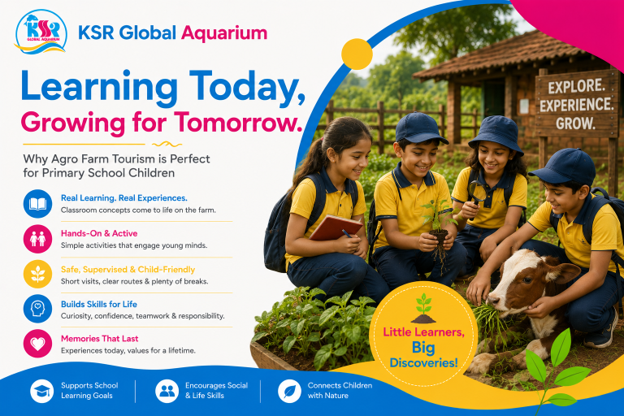
The agro-farm tourism provides primary school children with a safe and hands-on learning day. They are able to observe crops, animals, tools and food systems being used. It is suitable for science, nature studies and learning in teams. A lot of the farms also offer guided walks, feeding the animals, basic harvesting and tasting the local food in the agro tourism of Maharashtra. Schools find short, carefully planned and fun visits the best.
Introduction
The agro farm tourism is a great opportunity to provide primary school children with an out-of-the-classroom learning day. It allows them to experience crops, animals, soil and food production in the real world, making lessons easier to understand and remember.
This kind of travel helps to foster curiosity, teamwork and an appreciation for the natural world in young learners. When properly planned, it also provides a safe balance of learning and fun.
Areas such as agro tourism in Maharashtra offer kids options for farm tours and educational activities that are interactive, hands-on and meaningful.
Is agro farm tourism good for primary school children?
Yes, because it makes classroom ideas tangible and real work. Children see how vegetables grow, the feel of the soil, how animals are cared for, etc. This helps to remember the lesson.
These types of outings are also appropriate for young children because they are active, open, and low-pressure. They don’t require screens or extended lectures. They engage by using simple activities, movement and observation.
The ideal visit for primary school groups is one that is brief and is well supervised. A good farm has clear routes, simple activities and ease of rest breaks. Primary pupils learn best by example. A seed tray, compost heap or cow shed is a better educator than a worksheet.
It also works to support various learning styles. Visual learners see the process. Kinaesthetic learners move into the group. Children ask questions and develop confidence. A visit to a farm can also help to develop social skills. Children take turns, listen to instructions and work in small groups.
What activities are usually involved on a school day trip?
Each day features a farm walk, crop observation, animal feeding and a hands-on activity. Children will also have the opportunity to witness the irrigation, kitchen gardens, composting and local food preparation.
| Activity | What children do | Learning value |
| Farm walk | Follow a guide around fields or gardens | Understand crops and seasons |
| Animal care | Feed goats, hens, or cows | Learn responsibility and empathy |
| Harvesting | Pick fruit, vegetables, or herbs | See where food comes from |
| Soil learning | Touch soil, seeds, and compost | Understand plant growth |
| Local food | Taste simple regional snacks | Connect farming and food |
Agro farm tourism in Maharashtra often focuses on local, practical experiences such as sugarcane, rice, vegetables, fruit, and dairy. Some farms also add short, supervised tractor rides, folk games, pottery, and village cooking demos to make the visit more engaging for children.
How does the trip support classroom learning?
It supports science, environmental awareness, and life skills. Children see germination, weather impact, insects, water use, and food production in one place. A farm visit makes abstract topics easier to understand. A teacher can explain pollination in class. A farm shows it happening in real life.
The trip also strengthens language learning. Children describe what they see, ask questions, and use new vocabulary. That improves memory and communication. Schools often use these visits for project work too. Children can draw plants, write reflections, or make a simple farm diary after returning.
Science benefits the most. Nature studies, geography, and environmental lessons also fit well. Maths can join in through counting plants, measuring leaves, or comparing crop rows. Even art lessons improve through sketching animals and landscapes.
For many schools, these visits are attractive because they support several subjects in one day. That makes the outing feel purposeful.
What should schools and parents check before booking?
Safety should come first. Ask about supervision, toilets, drinking water, first-aid support, shaded areas, and route safety.
Check whether the farm has child-friendly spaces. Steps, muddy paths, and open water areas need careful control. Younger children need shorter walking distances too.
| Checkpoint | What to ask | Why it matters |
| Supervision | How many adults guide each group? | Keeps children safe |
| Hygiene | Are wash areas and toilets clean? | Protects health |
| Activity length | How long is each stop? | Prevents fatigue |
| Weather cover | Is there shade or indoor space? | Helps in heat or rain |
| Food options | Are meals suitable for children? | Avoids discomfort |
A trusted venue should explain timings clearly. It should also share emergency contact details in advance.
At KSR Global Aquarium, families often look for learning-led outings. That same standard helps when choosing a farm trip for children.
How can you choose the right visit for your school or family?
Start with the learning goal. Decide whether you want science, nature awareness, food education, or simple outdoor fun. Then match the farm to that goal. Ask for a sample itinerary before booking.
A good plan should show timings, activities, meal breaks, and safety support. That helps parents and teachers prepare children properly. Look for farms that balance fun with structure. Too much free time becomes messy. Too many lectures become boring. The best visits mix movement, discovery, and rest.
When chosen well, a farm visit can become one of the most memorable school experiences. It gives children practical knowledge they can use again. KSR Global Aquarium can be part of that wider family-learning mindset. Educational outings work best when they are engaging, safe, and easy to understand.
FAQ
Q1. Too much effort for children in primary school to visit a farm? No. Effective if the schedule is brief, in a shaded area, and well paced. Fewer stops and simple activities work well with younger children.
Q2. What should children be dressed in for the trip? It is best to wear comfortable clothes, shoes that cover your feet, a cap and a water bottle. They are dressed in light and functional clothing that allows them to move safely and comfortably.
Q3. Does a farm visit contribute to exam learning? Yes. Promotes knowledge of plants, animals, soil and food systems. It is easier for children to remember a lesson topic when they experience it in reality.
Q4. Can agrofarming tourism be limited to just rural schools? No. Also, urban schools benefit. Children living in cities may benefit most, since they do not typically have the opportunity to get up close with farming.
Q5. Why Do Teachers Love Agro Tourism in Maharashtra? One day of learning, activity and outdoor experience. The trip could be linked with topics in science, geography and environmental studies.
Conclusion
Primary school children can enjoy a farm visit. It is fun and active and teaches real-life skills and is linked to school subjects. The safest and simplest trips are the best ones. They should demonstrate to children the relationship between food, nature and caring.
When it comes to choices for agro tourism in Maharashtra, the ideal destination will appear both informative and fun. The value of agrotourism to young learners is that.
Contact KSR Global Aquarium today to schedule an appointment or talk to an expert.