
By the KSR Global Aquarium team | Updated October 2026 | 9 min read
Is hand-feeding fish safe for the fish? Yes, it can be, as long as the pond controls three things: what food goes in, how much of it, and how clean the water stays. Koi and goldfish are hardy pond fish that take food from the surface naturally. The harm comes from the wrong food, too much of it, and leftovers rotting in the water.
Key insights
- The food matters more than the hand: proper pellets are fine, bread and snacks aren’t.
- Overfeeding is the real risk: uneaten food breaks down into ammonia, which damages gills and stresses fish.
- Species choice is half the welfare: koi and goldfish are built for pond life and surface feeding, which is why good ponds use them.
- Fish learn fast: fed fish lose their wariness quickly, which is lovely in a managed pond and a problem in the wild.
Before you feed
Use only the food the pond gives you, drop it in small pinches, and stop when the fish stop rushing. If food is floating untouched, they’re full. That one habit does more for the fish than anything else a visitor can do.
There’s a moment at every fish feeding pond. A child drops a pellet, forty orange koi pile up at the edge with their mouths open, and the whole family laughs. Then somebody, usually the parent who reads too much, quietly asks: “Is this actually OK for them?”
It’s a good question, and the honest answer is “it depends on the pond”. Hand-feeding isn’t cruel by default, and it isn’t harmless by default either. Below, we’ve laid out what the research says, what actually hurts fish, and what a properly run feeding pond does to keep them healthy.
[IMAGE: a child’s open palm just above the water, koi mouths breaking the surface towards it, shot low from pond level. Caption: Koi feed at the surface by nature, which is why they’re the standard fish for feeding ponds.]
Does hand-feeding hurt fish?
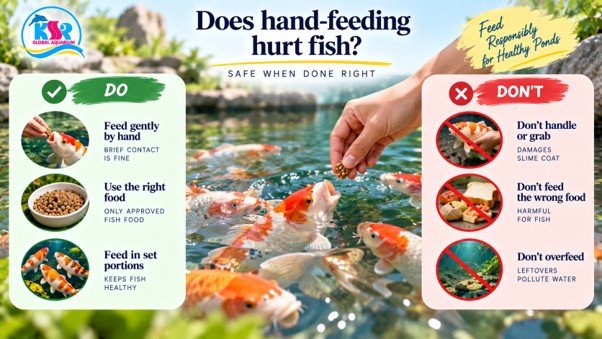
Hand-feeding itself doesn’t hurt pond fish like koi and goldfish. The harm comes from feeding the wrong food, feeding too much, and letting leftovers foul the water. In a managed pond with set portions and clean water, the fish stay healthy and active.
The touch itself
Brief contact when a fish takes food from your fingers isn’t a problem. Grabbing, stroking or lifting fish is, because it damages the protective slime coat on their skin. Feed, don’t handle.
The real culprits
Almost every welfare problem at a feeding pond comes back to food. Too much of it, the wrong kind, or food that sinks and sits there. Fix the food and you’ve fixed most of the risk.
What happens when fish are overfed?
Overfed fish leave food uneaten, and that food breaks down into ammonia and other nitrogen waste. Ammonia damages the gills, reduces the blood’s ability to carry oxygen and weakens the immune system. In a heavily visited pond, this is the biggest welfare risk.
Why ammonia is the problem
Ammonia is the main breakdown product of protein in fish food and fish waste. A review in Animals found that ammonia exposure in fish causes gill and tissue damage, oxidative stress and suppressed immune responses, and that the toxic form rises as water gets warmer, which matters in a Konkan summer.
Signs fish are being overfed
| What you see | What it usually means |
| Food floating untouched after a minute | The fish are full |
| Cloudy, green or smelly water | Leftover food and waste building up |
| Fish gasping at the surface when no one’s feeding | Low oxygen or poor water quality |
| Fish ignoring food entirely | Overfed, stressed or unwell |
| Foam or film on the surface | Excess organic matter in the water |
Why visitor feeding makes it harder
A home pond gets fed by one person who knows how much went in. A public fish park gets fed by hundreds of people, each of whom thinks their handful is the only one. That’s exactly why the pond, not the visitor, has to control portions.
What food is safe to give pond fish?
Proper floating pellets made for koi and goldfish are the safe choice, because they’re balanced for pond fish and stay at the surface where uneaten food can be seen and removed. Bread, biscuits, chips and puffed rice are not safe and shouldn’t be thrown in.
Why bread is bad
Bread swells in water and in the gut, has little nutrition for fish, and breaks up into fine particles that sink and rot. It’s one of the fastest ways to cloud a pond.
Why floating food matters
When food floats, staff can see what’s been eaten and skim off what hasn’t. Sinking food disappears and decays out of sight.
Safe vs unsafe at a glance
| Safe | Not safe |
| Koi or goldfish pellets supplied by the pond | Bread, buns, rotis |
| Small, measured portions | Chips, namkeen, biscuits |
| Feeding at the surface | Puffed rice, popcorn |
| Stopping when fish stop rushing | Emptying a whole packet at once |
Does feeding change how fish behave?
Yes. Fish that are fed regularly by people quickly stop being wary of them, gather where food usually appears and can become pushier with each other. In a managed pond this is harmless and even useful. In the wild it can disrupt natural behaviour.
What the research shows
A study in a Brazilian marine protected area open to tourists found that visitor feeding led to habituation to people, conditioning to handouts and more aggressive fish. That’s a strong argument against feeding wild fish on beaches and reefs, and a reason managed ponds exist.
Why a pond is different
A feeding pond is a controlled habitat. The fish are pond-bred, the food is chosen for them, and nobody’s relying on them to forage on a reef. Habituation there is the whole point, and it doesn’t knock on to a wild ecosystem.
A small rule for travellers
Feed fish at a proper feeding pond, and don’t feed them on beaches, rivers or reefs. Both can be true at once.
What does a well-run fish feeding pond do right?
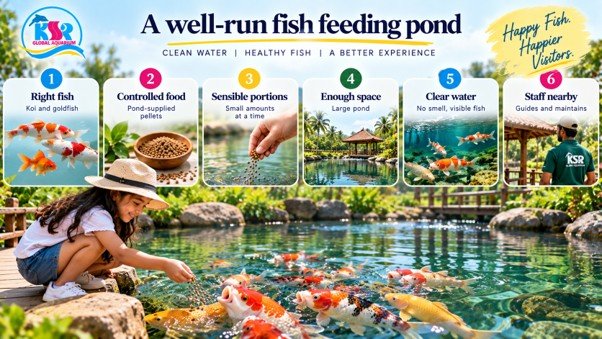
A well-run feeding pond uses hardy surface-feeding species, controls the food visitors get, keeps the water filtered and aerated, removes leftovers and watches the fish for signs of stress. Visitors should see clear water, active fish and food that’s being eaten, not floating.
The checklist we’d use anywhere
- The right fish: koi and goldfish, which are pond species that feed at the surface.
- Controlled food: pellets supplied by the pond, not outside snacks.
- Sensible portions: small amounts at a time rather than unlimited bags.
- Space: a pond large enough that the fish aren’t crowded at the edge all day.
- Clear water: no smell, no surface film, visible fish.
- Staff nearby: someone who’ll stop a visitor tipping in a whole packet.
How the pond at Kesari is set up
The fish feeding pond at Kesari is a large pond built specifically for feeding, which is rare in Maharashtra, and it’s stocked with koi and goldfish of several varieties. Size matters more than people think: more water means waste is diluted and the fish have room to move away when they’ve had enough.
What you can do as a visitor
Follow the staff, feed in pinches, keep hands gentle, and stop when the rush stops. The dos and don’ts for an aquarium visit apply here too: no tapping, no outside food, no flash right at the water.
Is a fish park better than an aquarium for kids?
A fish park with a feeding pond and an aquarium do different jobs: the aquarium shows you fish, the pond lets you interact with them. For children, the best day out has both, because the feeding is what holds their attention and the aquarium is what teaches them something.
What the aquarium adds
At Kesari, the two-storey aquarium is split into freshwater, marine and brackish sections, with species like discus and giant red-tailed catfish. It’s where “fish” turns into dozens of different animals with different needs.
What the pond adds
Contact. Kids remember the koi that came to their hand long after they’ve forgotten which tank had the discus.
Searching “aquarium near me”?
If you’re in Sawantwadi, Amboli, North Goa or anywhere in Sindhudurg, a combined fish aquarium park gives you both in one ticket and one trip, which is easier than chasing separate attractions.
Wrapping up
So, is hand-feeding fish safe for the fish? In a well-run pond, yes. The fish are pond species built for surface feeding, the food is controlled, and the water is kept clean. The welfare risks, overfeeding, bad food and fouled water, are all about management rather than the act of feeding itself. As a visitor, your job is easy: use the pond’s food, feed in pinches and stop when they’re full.
KSR Global Aquarium at Kesari runs one of the few dedicated hand-feeding ponds in Maharashtra, alongside a two-storey aquarium covering freshwater, marine and brackish life, so you can see the fish and meet them in the same visit. Check the day’s timings and come feed the koi the right way.
FAQs
Is it safe to hand-feed koi fish?
Yes, if you use proper pond pellets and small portions. Koi feed at the surface naturally and tolerate brief contact. Avoid grabbing or stroking them, and never feed bread, chips or biscuits.
Can you feed bread to fish?
No. Bread swells, offers little nutrition and breaks into particles that sink and rot, fouling the water. Use the pellets the feeding pond provides, which are made for koi and goldfish.
How do I know if pond fish are overfed?
If food floats untouched for more than a minute, the fish are full. Cloudy or smelly water, surface film and fish gasping at the surface are also signs of overfeeding and poor water quality.
Where can I feed fish near me in Sindhudurg?
Kesari, near Sawantwadi and Amboli, has a large dedicated koi and goldfish feeding pond inside a fish aquarium park. It’s about 45 minutes from Sawantwadi and roughly 3 km from Danoli.
Does feeding wild fish harm them?
It can. Research in marine protected areas found tourist feeding made fish habituated, food-conditioned and more aggressive. Feed fish at managed ponds, not on beaches, rivers or reefs. Managed ponds are the safer choice.
What fish are used in fish feeding ponds?
Koi and goldfish are the usual choices. They’re hardy pond species, feed happily at the surface and cope well with a managed, filtered pond, which makes them the standard for feeding ponds.