
By the KSR Global Aquarium team | Updated October 2026 | 9 min read
What is Sawantwadi famous for once you get past the lacquered wooden toys? Hand-painted circular Ganjifa cards, a royal palace beside the Moti Talao lake, cashew and kokum, Malvani cooking, and a setting squeezed between the Western Ghats and the sea. It’s also become a base for agro tourism in Maharashtra, with working farms and butterfly country a short drive away.
Key insights
- The toys are the headline, Ganjifa is the rarity: full 120-card Dashavatara sets are still painted by hand here, and very few places in India can say that.
- It was a capital, not a village: Sawantwadi was the seat of the Sawant Bhonsle kingdom, and the palace and lake are what’s left of that.
- The food is Malvani, not Goan: it sits right on the border, but the kitchen is its own thing.
- The countryside is the quiet star: farms, cashew orchards and butterfly villages are why many families stay an extra day.
Before you go
Buy craft directly from the workshops if you can, and ask to see something being painted. You’ll pay roughly what a shop charges, but the money goes straight to the family doing the work, and you’ll understand why a “simple” wooden mango takes as long as it does.
Most people know Sawantwadi for one thing. Mention it to anyone from Mumbai or Pune and they’ll say “oh, the wooden toys”, usually followed by a memory of a painted fruit basket on a relative’s shelf.
That’s fair, the toys are lovely. But stopping there is a bit like saying Kolhapur is famous for chappals. True, and only a tiny slice of it. So if you’re planning a trip, or you’ve already arrived and you’re wondering what else is worth your time, here’s the fuller picture.
[IMAGE: close-up of an artisan’s hands painting a circular Ganjifa card, brushes and pigment pots on a wooden table. Caption: A full Dashavatara Ganjifa set runs to 120 hand-painted cards.]
What crafts is Sawantwadi known for, apart from toys?
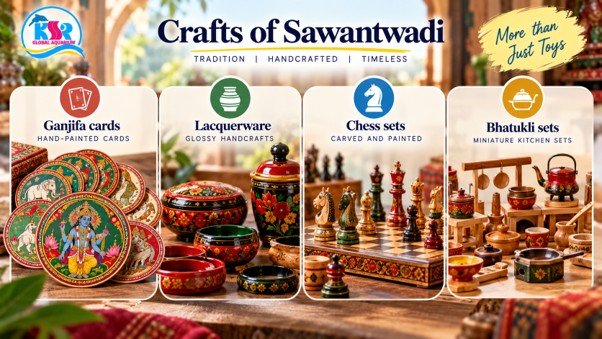
Sawantwadi is known for Ganjifa playing cards, lacquerware, painted chess sets and Bhatukli miniature kitchen sets, alongside its wooden fruit and figurines. Most of this work traces back to the Chitari artisan families who settled here centuries ago.
Ganjifa cards
Ganjifa is a circular, hand-painted card game with Persian roots that was reworked here around Indian themes like the Dashavatara and the zodiac. A full Dashavatara set has 120 cards, and Outlook Traveller notes that artisans in Sawantwadi still hand-paint full 120-card sets, a tradition that survives in only a handful of places in India.
Lacquerware
The glossy finish on the toys is lacquer, applied and polished by hand. You’ll also find lacquered boxes, bangles and decorative pieces, which travel better than a full fruit basket.
Chess sets and Bhatukli
Carved chess sets and Bhatukli, the miniature kitchen sets children play house with, are both local specialities. Bhatukli is a lovely gift for a small child who’s outgrown plastic toys.
Why the craft feels fragile
A recent FLAME University study of the Chitari, Ganjifa and toy traditions found artisans dealing with raw material scarcity and limited economic opportunities. Buying direct isn’t charity, it’s simply how the craft keeps paying.
What is the history behind Sawantwadi?
Sawantwadi was the capital of the Sawant Bhonsle kingdom, a princely state on the Konkan coast. Its palace and the Moti Talao lake beside it date to the 18th century, and the royal family’s patronage is a big reason the crafts survived at all.
The palace
Sawantwadi Palace is built in a Konkan style with timbered roofs and carved wood. Part of it houses a small museum, and part is used as a heritage stay and artisan workspace, so you can see craft being made on site.
Moti Talao
The lake in the middle of town is where Sawantwadi goes for its evening walk. It’s not a “sight” so much as the town’s living room, and it’s at its best around sunset.
A contested coast
The region was pulled between the Marathas, the Mughals and the Portuguese in Goa over the centuries. That mix shows up in the architecture, the food and even the languages: you’ll hear Malvani, Marathi and Konkani in the same market.
What food is Sawantwadi famous for?
Sawantwadi is famous for Malvani food, especially fish curries, kombdi vade and sol kadhi, plus local cashew, kokum and seasonal Alphonso mangoes. It’s close to Goa, but the cooking leans firmly Malvani, with coconut, kokum and red chilli doing most of the work.
What to try
| Dish or product | What it is | When to look for it |
| Sol kadhi | Kokum and coconut milk drink, pink and cooling | All year |
| Kombdi vade | Chicken curry with fried rice-flour puris | All year |
| Fish thali | Rice, curry, fried fish, sol kadhi | October to May for the best catch |
| Cashews | Locally processed, sold loose and roasted | All year, freshest after the spring harvest |
| Kokum | Dried rind, syrup and agal for cooking | All year |
| Alphonso mangoes | The Konkan’s famous mango | April to June |
Vegetarian? You’re fine
Malvani kitchens are known for seafood, but vegetarian thalis are easy to find, and plenty of farm stays and day attractions serve pure veg meals.
Is Sawantwadi good for agro tourism?
Yes. The countryside around Sawantwadi is full of cashew orchards, paddy fields, coconut groves and small farms, which makes it one of the easier places for agro tourism in Maharashtra. Families can plant, harvest, meet farm animals and eat farm-to-table meals within a short drive of town.
What agro farm tourism looks like here
It’s not a resort with a cow in the corner. A good agro farm tourism day involves getting your hands dirty: planting a sapling, picking whatever’s in season, feeding animals and eating what was grown nearby. At Kesari, the agro tourism section runs hands-on planting, harvesting and animal tending, with farm-to-table meals and folk performances.
Why it works with kids
City children rarely see where food comes from. An hour pulling vegetables and feeding goats does more for that than any textbook, and it’s the part of the trip many of them talk about later.
The seasons matter
| Season | What farms are doing |
| June to September | Paddy planting, everything green and wet |
| October to January | Harvest, pleasant weather, best for families |
| February to May | Cashew and mango season, hot by midday |
What natural attractions is Sawantwadi known for?
Sawantwadi sits at the foot of the Western Ghats, so it’s known for Amboli’s monsoon waterfalls, butterfly-rich forest villages and quiet beaches like Velagar near the Goa border. The hills and coast are both within an hour.
Amboli
The last hill station before the coast. It’s famous for waterfalls and mist in the monsoon and for frogs, snakes and butterflies that draw wildlife photographers.
Butterfly country
Parpoli, close to Kesari, is known as a butterfly village. If you’d rather see butterflies up close with a guide, the Dome of Colors at Kesari keeps Western Ghats species in a planted enclosure, including Blue Pansy and Painted Courtesan.
The coast
Vengurla and Velagar give you beaches without Goa’s crowds. Go for a slow afternoon, not a party.
How do you see the best of Sawantwadi in one day?
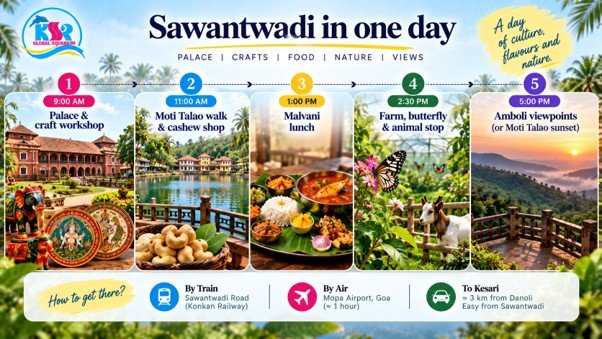
Start at the palace and craft workshops in the morning, eat a Malvani lunch in town, then head out to the farms, butterfly villages or Amboli in the afternoon. Keep the coast for a second day if you have one.
A simple day plan
- 9 a.m.: palace museum and a craft workshop.
- 11 a.m.: Moti Talao walk and a cashew shop.
- 1 p.m.: Malvani thali in town.
- 2.30 p.m.: farm, butterfly and animal stop around Kesari.
- 5 p.m.: Amboli viewpoints in the monsoon, or back to Moti Talao for sunset.
Getting there
Sawantwadi Road is on the Konkan Railway, and Mopa airport in North Goa is about an hour away. Kesari is about 3 km from Danoli, and the route from Sawantwadi is straightforward once you know the turn.
Wrapping up
So what is Sawantwadi famous for? Wooden toys, yes, but also Ganjifa cards that almost nobody else still paints, a palace and lake from its days as a royal capital, Malvani food you’ll want to recreate at home, and a green, farmed countryside that’s ideal for slow travel. Give it a full day rather than a toy-shop stop.
If the countryside part appeals, KSR Global Aquarium at Kesari puts a working agro farm, a butterfly dome, a walk-through bird park and an aquarium on one site, about 45 minutes from Sawantwadi town. It’s an easy way to add farm life and wildlife to a craft-and-heritage morning. Check the day’s timings and plan your afternoon there.
FAQs
What is Sawantwadi famous for?
Sawantwadi is famous for lacquered wooden toys, hand-painted Ganjifa cards, its royal palace and Moti Talao lake, Malvani food, cashews and kokum. It’s also a base for Amboli, the Konkan coast and agro tourism.
What are Ganjifa cards?
Ganjifa cards are round, hand-painted playing cards of Persian origin, adapted in Sawantwadi to Indian themes like the Dashavatara. A full Dashavatara set has 120 cards, and only a few artisan families still paint them.
Where can I buy Sawantwadi wooden toys?
Buy from the artisan workshops around the town’s craft area or the palace workspace. Buying direct supports the families who make them, and you can often watch the painting and lacquering being done.
Is Sawantwadi good for agro tourism?
Yes. Cashew orchards, paddy fields and small farms surround the town, and several places offer hands-on planting, harvesting and animal care. October to January is the most comfortable season for families.
What food should I try in Sawantwadi?
Try sol kadhi, kombdi vade, a Malvani fish thali and locally roasted cashews. In April to June, look for Alphonso mangoes. Vegetarian thalis are easy to find too. Ask locals for their favourite spot.
How many days do you need in Sawantwadi?
One full day covers the palace, crafts, food and a countryside stop. Two days let you add Amboli or the coast at Vengurla without rushing, which is the better option for families.